
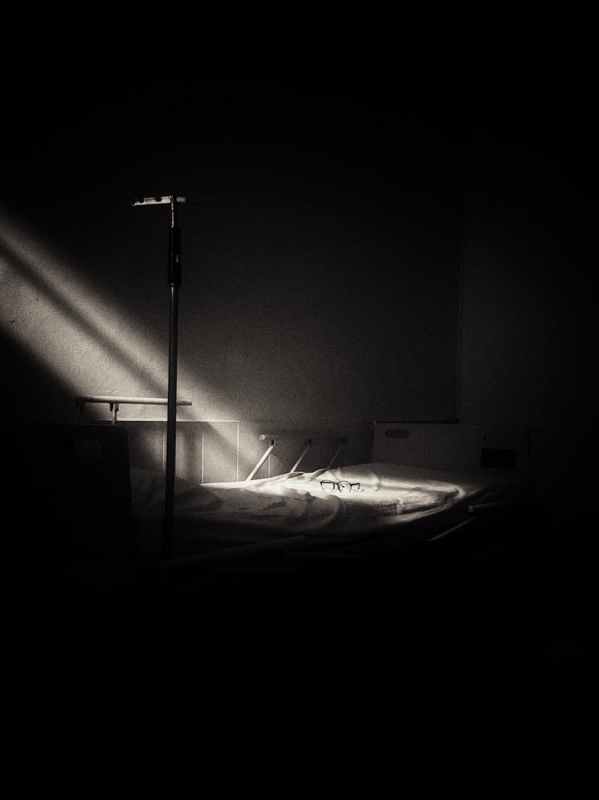
My aunt’s eyes are closed now, and so they’ll remain—in all likelihood—forever more.
When I visit her at the hospital, a well-meaning customer service person leads me to her, blurting at me on the way: “It’s an end of life situation, were you aware?” Ugh, what if I wasn’t? I had been holding out some hope. Was that really the best thing to say?
My aunt is 86. We’ve had many scares with her before, and she’s a tough old bird. She’s survived at least half a dozen serious falls. She got over hospital-contracted COVID-19 just fine, despite her lifelong ‘weak chest’.
It does seem more serious this time. They’ve stopped all interventions apart from the extra-strong ‘hydromorphine’, injected directly into a vein that’s kept open in her leg.
Her breath is noisy. Is it the death rattle you hear about? A doctor said she’s got aspiration pneumonia. We guess that means she breathed in some food or drink.
We sit around her bed in vigil: sister, daughter, nephew, niece.
We talk among ourselves. We talk about her life.
We try to be useful. Get an extra blanket to cover her feet, which she keeps poking out—even though they don’t feel cold. Cover her bare shoulder. Uncover her grasping hand, when she appears to want that. Request a lower pillow for her head.
We can’t tell if any of this makes her more comfortable, but it does help us feel a little better.
Two of us head to the café to bring back supplies.
More chatter.
We step out while they clean up her last stool. There’s a stink to high heaven that lingers for a long time. My nephew is once again grateful he’s anosmic.
They’ve stopped giving her the antibiotics for her UTI. They’re not giving fluids, nor feeding her with a tube. She’s not on oxygen any more.
Just before the dawn seems to be when people die, so my cousin was called at 3 am the other night, to come in. False alarm.
I’m up early today, waiting to see if there’s any news. There isn’t.
I’m not sure whether the pain meds are so strong they preclude her waking up again and just starting to eat and drink. I can see her surprising everyone like that—living another few years.
*
My aunt opened her eyes later in the day, and tried to speak. I’m too tired to visit her tonight, but I’ll try tomorrow — if she’s still with us.
*
She’s still there. I’m met by a hugely cavernous gaping mouth, one eye half open, the other sealed shut. I’m taken aback by the change in two days dying.
My aunt’s eyes are deeply sunken. She’s desiccating — dying of self-imposed hunger and thirst. The end of life plan she prepared years ago dictates no further treatment after this point. In addition to the hydromorphone, the nurse tells us there’s some kind of medication ‘to deal with the secretions’. She doesn’t explain further, but it reminds me of something I read in a Buddhist book about dying. As you near death, liquid begins to pour from all orifices.
The last word my aunt will ever speak is probably ‘No’. She’s been repeating it whenever they try to wipe her eyes, or turn her. They do it anyway — she lost the final vestiges of her right to Consent along with her consciousness.
Discover more from Wordflower Poetry
Subscribe to get the latest posts sent to your email.
 Wordflower Poetry
This reminds me of my grandmother being in the hospital. She didn’t want to eat, and my mother and grandfather kept trying to force her. It was very upsetting.💔
LikeLiked by 1 person
Consent is a thing! Dignity and choice should be offered to all
LikeLiked by 1 person
That said, they were doing their best and wanted her to live I’m sure
LikeLike